Corporate Poison : Natural Flavour
The Two Words That Legally Mean Almost Nothing
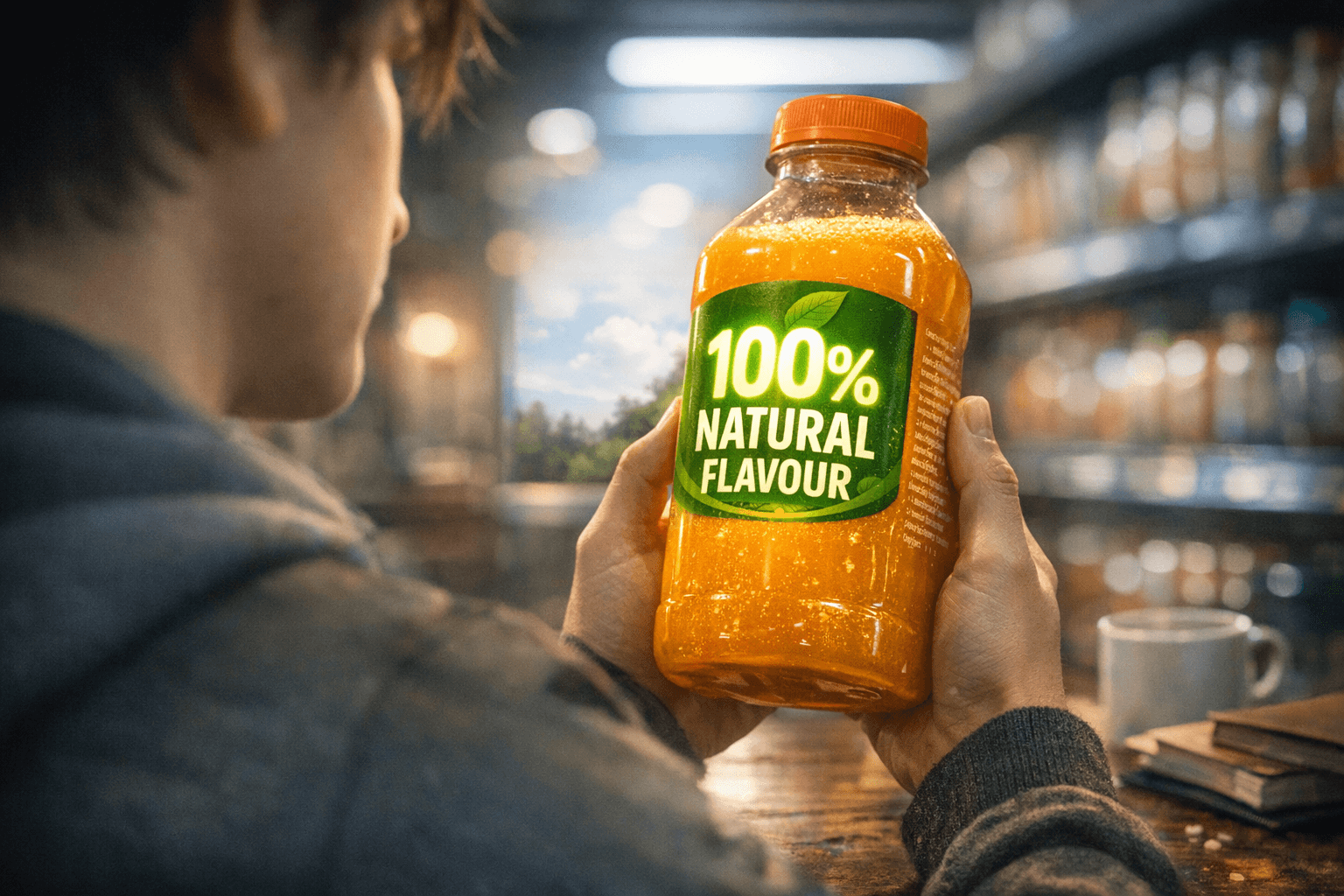
Walk into any supermarket and look at the front of a packaged food label.
You’ll see words like:
Natural flavour
Made with natural ingredients
Naturally flavoured
Nature-inspired taste
These phrases appear everywhere — from fruit juices and biscuits to yogurt, cereals, chips, and even protein powders.
For the average shopper, the message seems obvious.
“Natural” means something that came from nature.
Fruit. Herbs. Spices. Real ingredients.
Something wholesome. Something safe.
But the reality is far more complicated — and far less comforting.
The phrase “Natural Flavour” is one of the most powerful marketing tools in the modern food industry. It creates a strong psychological impression of purity and authenticity.
Yet in legal terms, it can describe chemical compounds that were manufactured inside industrial laboratories.
In many cases, the strawberry flavour in your drink may never have seen a strawberry.
The vanilla in your biscuit might not come from a vanilla bean.
And the mango flavour in your candy may have started its life as a petroleum derivative.
The trick isn’t the chemistry itself.
The trick is the language.
Because two words on a label are doing most of the work.
“Natural flavour.”
The Psychology of the Word “Natural”
The food industry understands something fundamental about human psychology.
Consumers fear chemicals.
But they trust nature.
If a label says “artificial flavour,” people hesitate.
If the same compound is described as “natural flavour,” the product suddenly feels healthier, safer, and more premium.
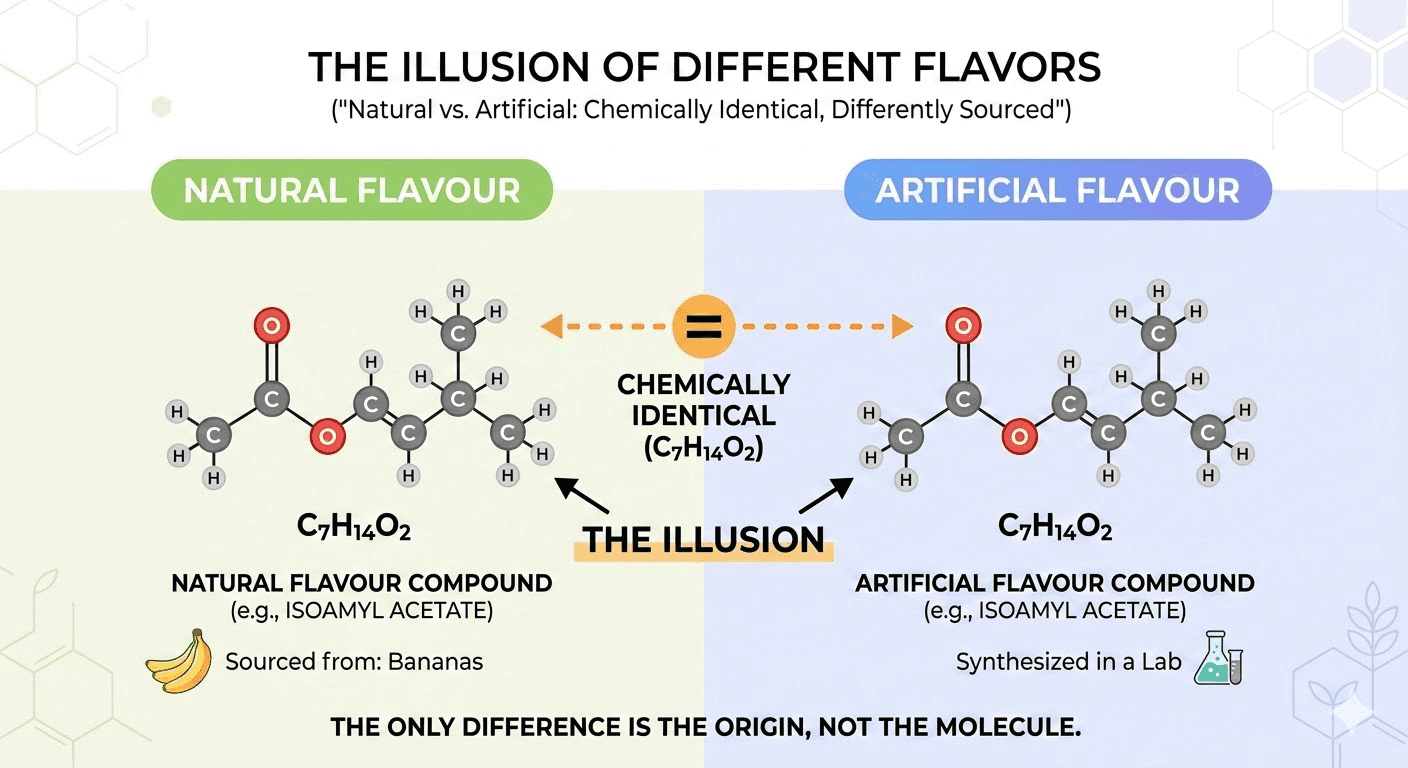
Even though the chemical molecule may be identical.
This psychological effect is called the “naturalness bias.”
Our brains automatically assume that natural things are:
safer
healthier
less processed
more nutritious
But in the world of industrial food production, these assumptions often collapse.
Because the word “natural” on food labels does not mean what most people think it means.
What “Natural Flavour” Actually Means (Legally)
Food labeling laws across many countries — including India — allow manufacturers to use the term “natural flavour” if the flavouring compound originally came from a natural source.
But here’s the key detail.
The final ingredient inside your food does not need to come directly from that source.
The compound may have been:
extracted
purified
chemically modified
concentrated
reconstructed in a laboratory
As long as the original molecule exists somewhere in nature, the final result can legally be called “natural flavour.”
This creates a massive grey zone.
For example:
A strawberry contains dozens of aromatic compounds that create its flavor.
Scientists can identify these molecules, isolate them, and reproduce them in a lab.
The end result may taste exactly like strawberry.
But it might have been manufactured from completely different raw materials.
Sometimes even wood pulp, corn starch, or petrochemical derivatives.
Yet the label can still say “Natural Strawberry Flavour.”
Technically legal.
Practically misleading.
The Strawberry That Never Met a Strawberry
One of the most famous examples in food science is the compound ethyl methylphenylglycidate, sometimes called the “strawberry aldehyde.”
This molecule is responsible for a key part of strawberry aroma.
Food chemists can synthesize it industrially.
When added to drinks, candies, or yogurt, it produces a convincing strawberry taste.
But the compound may never come anywhere near an actual strawberry.
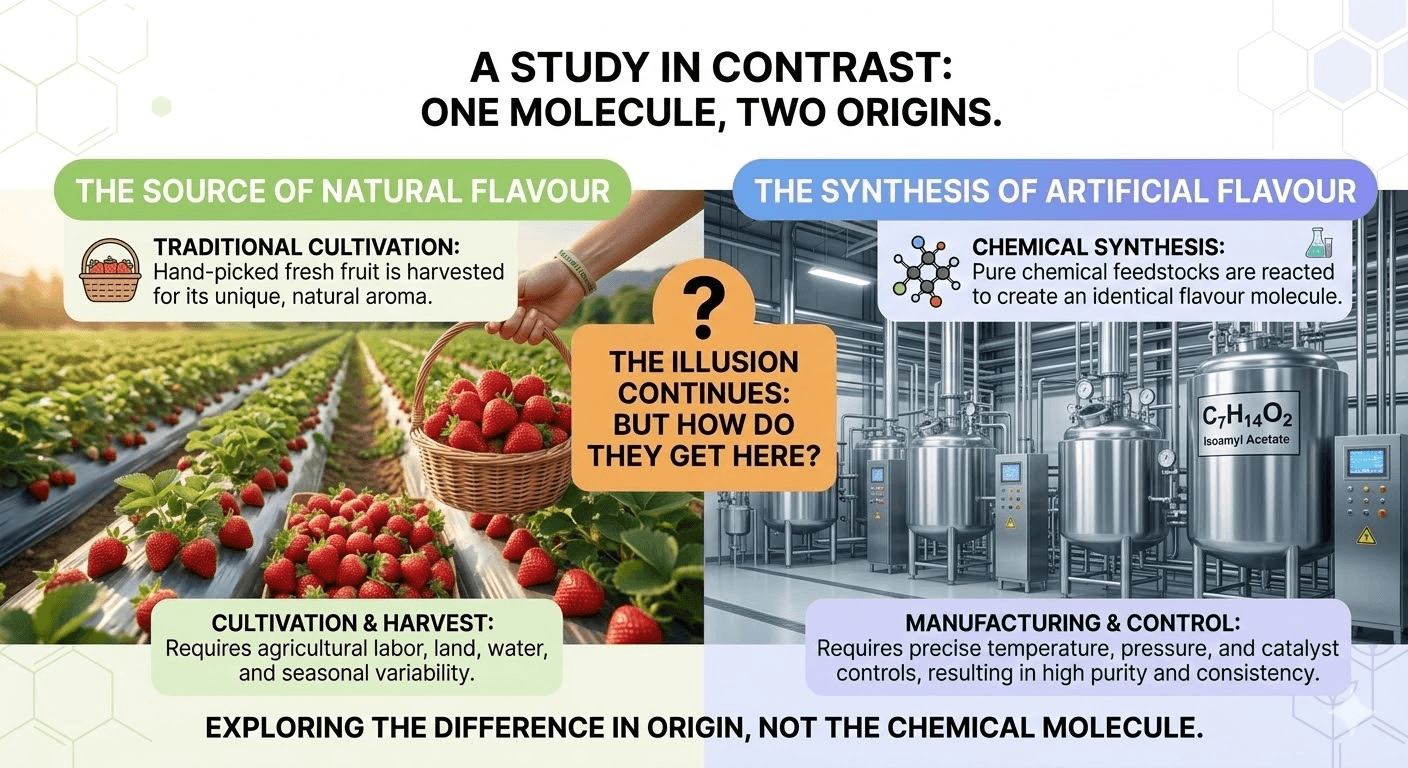
Instead, it can be derived from basic chemical feedstocks and produced in large industrial batches.
Yet if the molecule itself exists in strawberries, the label can still say “natural flavour.”
Consumers imagine farms and orchards.
The reality may involve chemical reactors and stainless-steel tanks.
Why Companies Prefer Flavour Chemistry
If companies could simply use real fruits, spices, and herbs, why go through the trouble of flavour engineering?
The answer is economics and logistics.
Real ingredients are expensive.
They are seasonal.
They spoil quickly.
Their taste varies depending on weather, soil conditions, and harvest timing.
Flavor chemistry solves all these problems.
Artificial or reconstructed flavours are:
1. Cheaper
Extracting flavor compounds from real fruit requires huge quantities of raw material.
For example, producing natural vanilla extract requires thousands of vanilla beans.
Synthetic vanillin can be produced far more cheaply.
2. Stable
Real ingredients degrade quickly.
Engineered flavor molecules remain stable for months or years.
3. Consistent
A mango harvested in June may taste slightly different from one harvested in July.
Flavor chemistry ensures the taste remains identical in every batch.
For global food brands producing millions of units daily, consistency is essential.
The result is a food system where flavour is increasingly separated from the food itself.
Taste is no longer coming from ingredients.
It is coming from chemical formulas.
The Ingredient List Illusion
Another clever trick appears in ingredient lists.
You may see something like:
Ingredients:
Sugar, wheat flour, vegetable oil, cocoa powder, natural flavour.
That last phrase looks harmless.
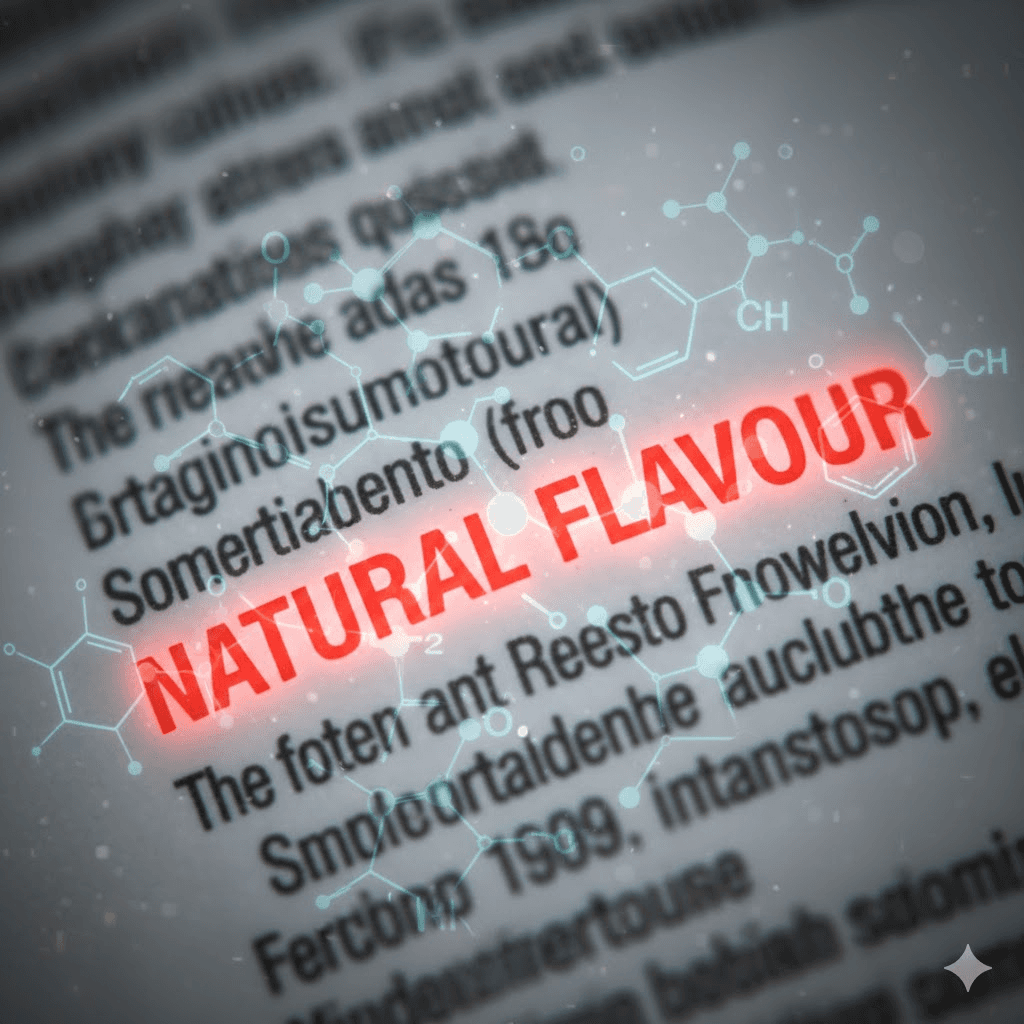
But it can represent a mixture of dozens of chemical compounds.
Manufacturers are not required to list each compound individually.
Instead, they can group them under the umbrella term “natural flavour.”
This protects trade secrets — companies do not want competitors copying their flavor formulas.
But it also hides complexity from consumers.
The result is a single vague phrase that could represent a surprisingly complex chemical blend.
Is “Natural Flavour” Dangerous?
This is where nuance is important.
The presence of natural flavour compounds does not automatically mean a food is unsafe.
Many flavor molecules — whether natural or synthetic — are tested and approved by regulatory authorities.
In small quantities, they are generally considered safe.
The bigger issue is not toxicity.
The issue is transparency and perception.
Consumers believe they are buying something close to real food.
But what they are often getting is a highly engineered taste experience built around refined sugar, refined flour, and industrial oils.
The flavor chemistry simply masks the lack of real ingredients.
For example:
A strawberry yogurt may contain:
sugar
milk solids
stabilizers
natural strawberry flavour
But almost no actual strawberries.
Without the engineered flavor compound, the product would taste bland.
The Bigger Pattern: Marketing Over Ingredients
“Natural flavour” is part of a broader marketing strategy used across the processed food industry.
Other examples include:
“Made with Real Fruit”
Sometimes meaning less than 2% fruit content.
“Multigrain”
Even if most of the product is refined flour.
“No Added Sugar”
While containing fruit concentrates that behave like sugar.
These phrases are designed to communicate a feeling of health, not necessarily the reality of nutrition.
They are legally safe statements that sit in the gap between marketing and science.
How to Read Labels More Critically
Once you understand how these terms work, reading food labels becomes easier.
Here are three simple rules.
Rule 1: Look at the First Three Ingredients
Food labels list ingredients in order of quantity.
If the first three are:
sugar
refined flour
vegetable oil
the product is primarily composed of those ingredients.
The flavouring is secondary.
Rule 2: Don’t Trust the Front of the Package
The front is marketing.
The back is information.
Always read the ingredient list.
Rule 3: Fewer Ingredients Usually Means Less Processing
Foods with short ingredient lists are typically less engineered.
For example:
Peanut butter with:
Peanuts, salt
is far simpler than peanut butter containing:
sugar, vegetable oil, emulsifiers, natural flavour.
The Real Meaning of “Natural”
In modern food marketing, the word “natural” has become more about perception than reality.
It signals simplicity.
Purity.
Wholesomeness.
But behind the scenes, modern food production relies heavily on chemistry, engineering, and industrial scale processing.
Flavor science itself is not inherently bad.
In fact, it is a fascinating field that helps create safe, stable, and enjoyable foods.
The problem arises when the language used to describe those foods misleads consumers into believing they are eating something far closer to nature than they really are.
“Natural flavour” is not necessarily harmful.
But it is rarely what people imagine.
The Long Game
The most powerful change in food awareness is simple.
Curiosity.
When you begin reading labels and questioning vague phrases, the illusion starts to dissolve.
Suddenly you notice how often certain words appear.
Natural.
Wholesome.
Pure.
Real.
These words are not always lies.
But they are often carefully crafted impressions.
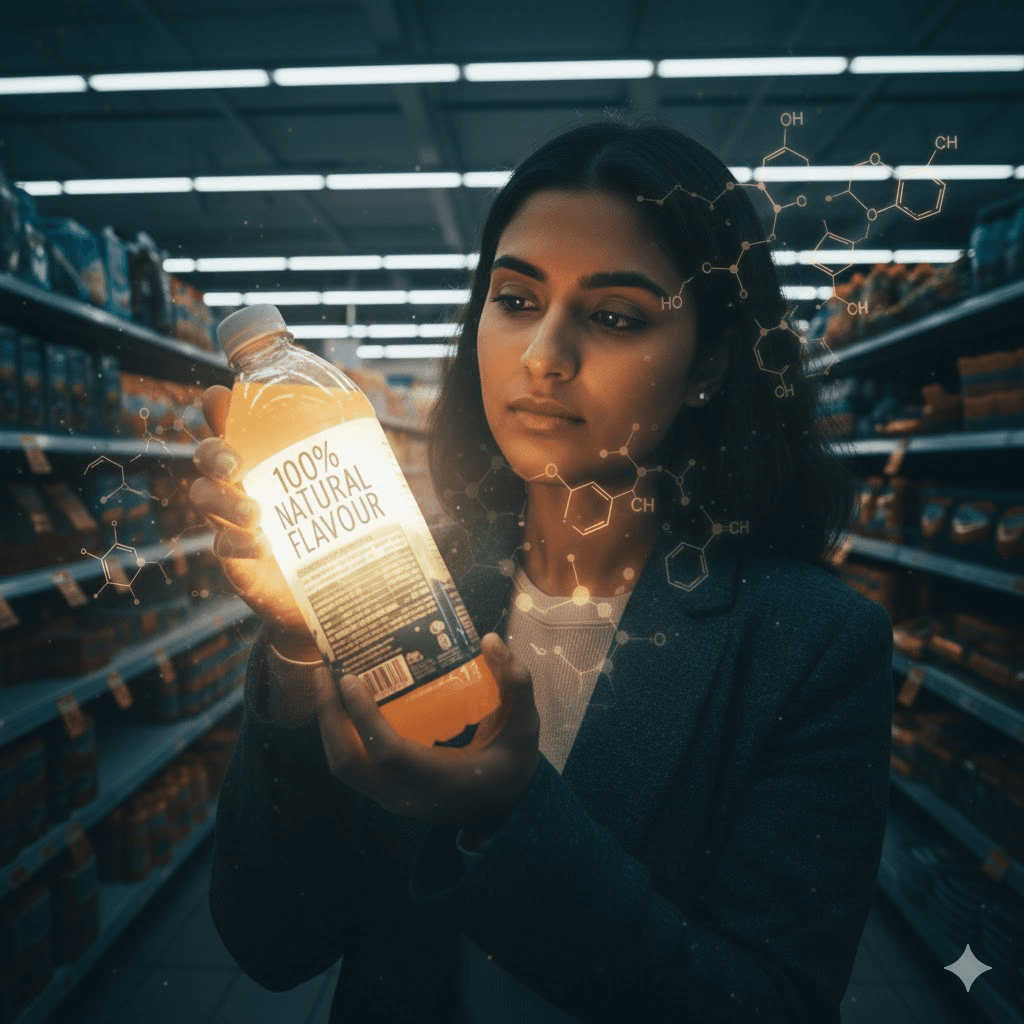
The next time you see “Natural Flavour” printed proudly on the front of a product, take a moment to flip the package over.
Look at the ingredient list.
And remember:
Two words on a label can hide an entire laboratory of chemistry.
Knowing that difference is the first step toward becoming a smarter eater.

Reading Time
9 min read