Corporate Poison – The Rusk Trap
Is Your "Light" Snack a Sugar Bomb?
It is, without exaggeration, one of the most deeply ingrained food rituals in Indian culture: the morning chai-rusk. Your grandmother had it. Your parents have it. Your colleague at the office pantry is probably having one right now.
We call it "light." We say "it's just dry bread." We reach for it because it feels like the responsible choice — not a samosa, not a paratha dripping with ghee, not a biscuit loaded with chocolate. Just a simple, crispy rusk. A nothing snack.
Except it's not nothing. Beneath that familiar golden crunch is one of the most heavily processed items hiding in plain sight in your kitchen. And the companies that make it are counting on you never flipping the packet over.
What Exactly Is a Rusk?
A rusk is essentially bread that has been baked twice. The first bake creates the loaf. The second bake — at a lower temperature — removes all the moisture, giving it that characteristic dry crunch and a shelf life that can stretch to 6 months or more. In theory, it's simple.
But here's where the industrial version diverges from the homemade one your grandmother might have made. To mass-produce rusks that are uniformly golden, consistently crispy, and taste sweet enough to pair with unsweetened tea, manufacturers add a cocktail of ingredients that have nothing to do with "bread."
Let's break down what's actually in a standard commercially available rusk in India:
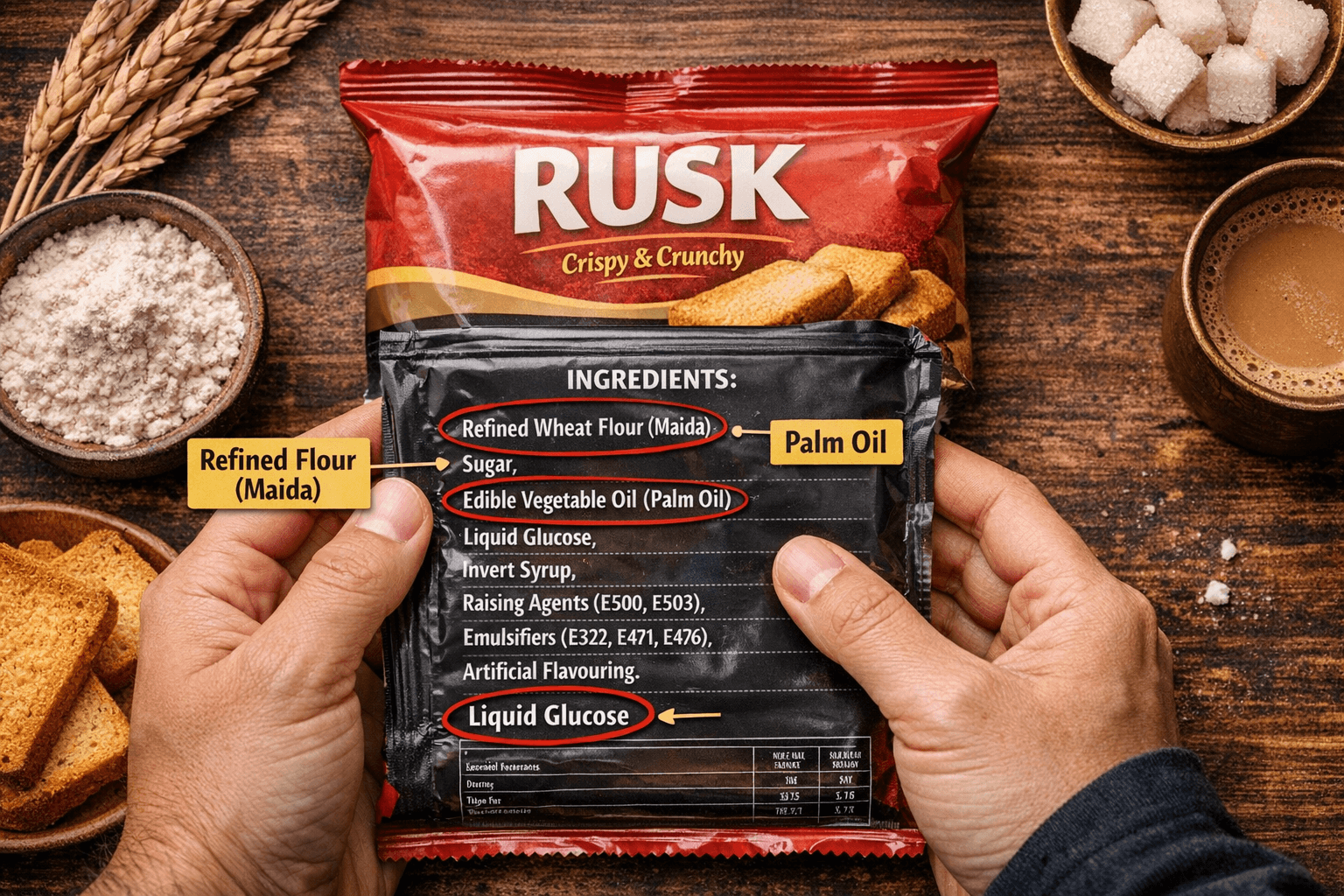
- Refined Wheat Flour (Maida): Not whole wheat. Maida is wheat that has been stripped of its bran and germ — the parts that contain fiber, vitamins, and minerals. What's left is essentially pure starch. It digests rapidly, spikes your blood sugar, and offers almost zero nutritional value.
- Sugar (and its cousins): This is where the trap lies. Most rusks contain between 20% and 30% sugar by weight. But it's rarely just listed as "sugar." You'll find it hiding under names like "Liquid Glucose," "Invert Sugar Syrup," "Maltodextrin," and "Dextrose." These are all engineered forms of sugar that are absorbed faster than regular table sugar, hitting your bloodstream like a freight train.
- Hydrogenated Vegetable Oil / Palm Oil / Vanaspati: This is what gives the rusk its richness and crunch. Vanaspati, in particular, is a partially hydrogenated fat — one of the primary sources of industrial trans-fats. Trans-fats are universally recognized as the single most dangerous type of dietary fat. They raise LDL (bad) cholesterol, lower HDL (good) cholesterol, and are directly linked to heart disease.
The 30% Sugar Rule
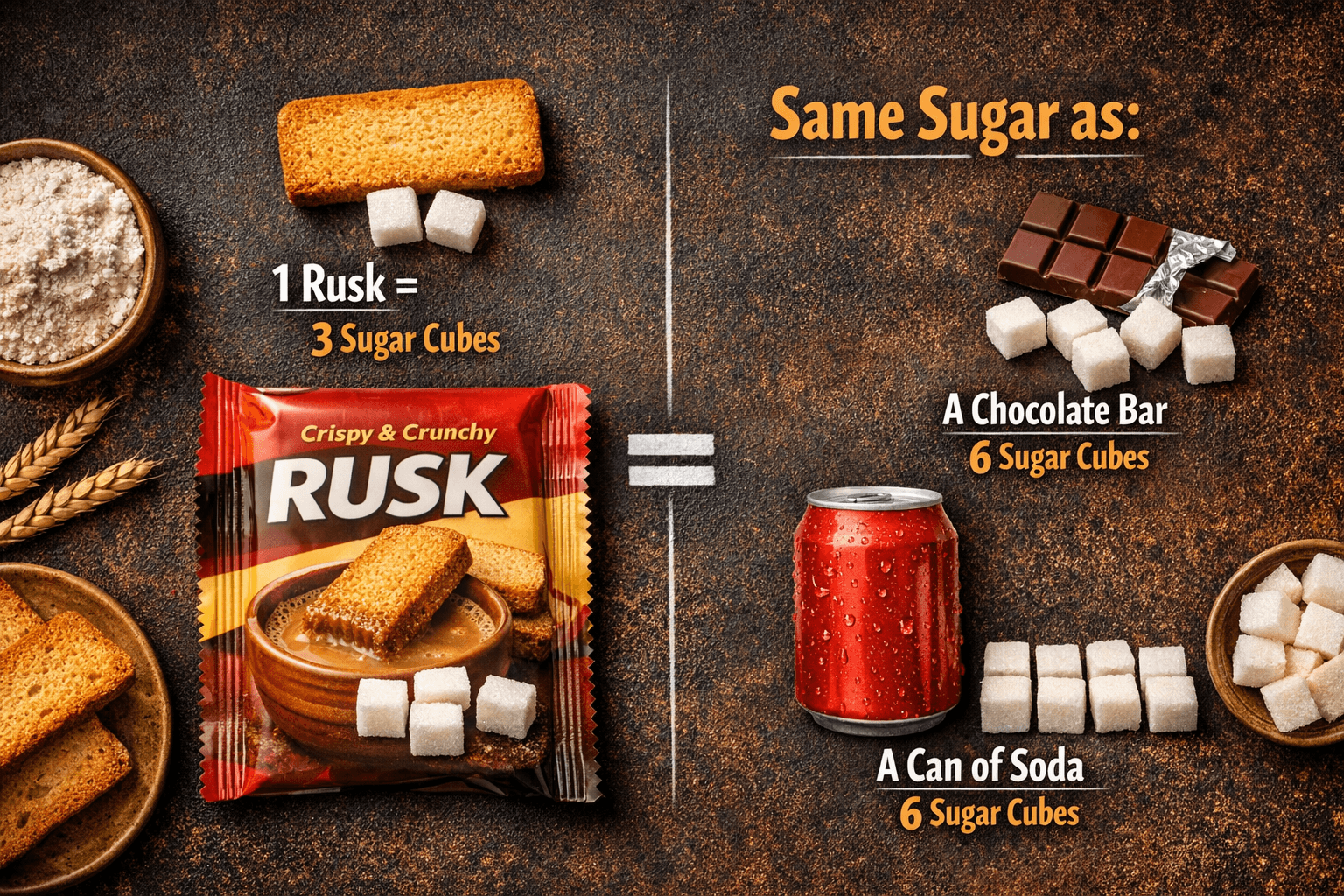
Let's do the math. A single rusk weighs approximately 25-30 grams. If the sugar content is 25% (a conservative estimate for most popular brands), that single rusk contains about 6-7 grams of sugar.
Now, WHO guidelines recommend that added sugars should make up less than 5% of your total daily caloric intake — roughly 25 grams for an average adult.
Two rusks with your morning tea? That's 12-14 grams of sugar. Already halfway through your entire day's recommended limit. And you haven't even had breakfast yet. Add the sugar in your tea itself, and you've likely crossed the limit before 9 AM.
For someone who is pre-diabetic — and according to the Indian Council of Medical Research, that's approximately 15.3% of all Indian adults — this "light snack" is enough to trigger a significant glycemic spike. The fast-absorbing sugars (Liquid Glucose, Invert Sugar) hit the bloodstream within minutes, demanding an urgent insulin response from an already-strained pancreas.
The Fiber Illusion
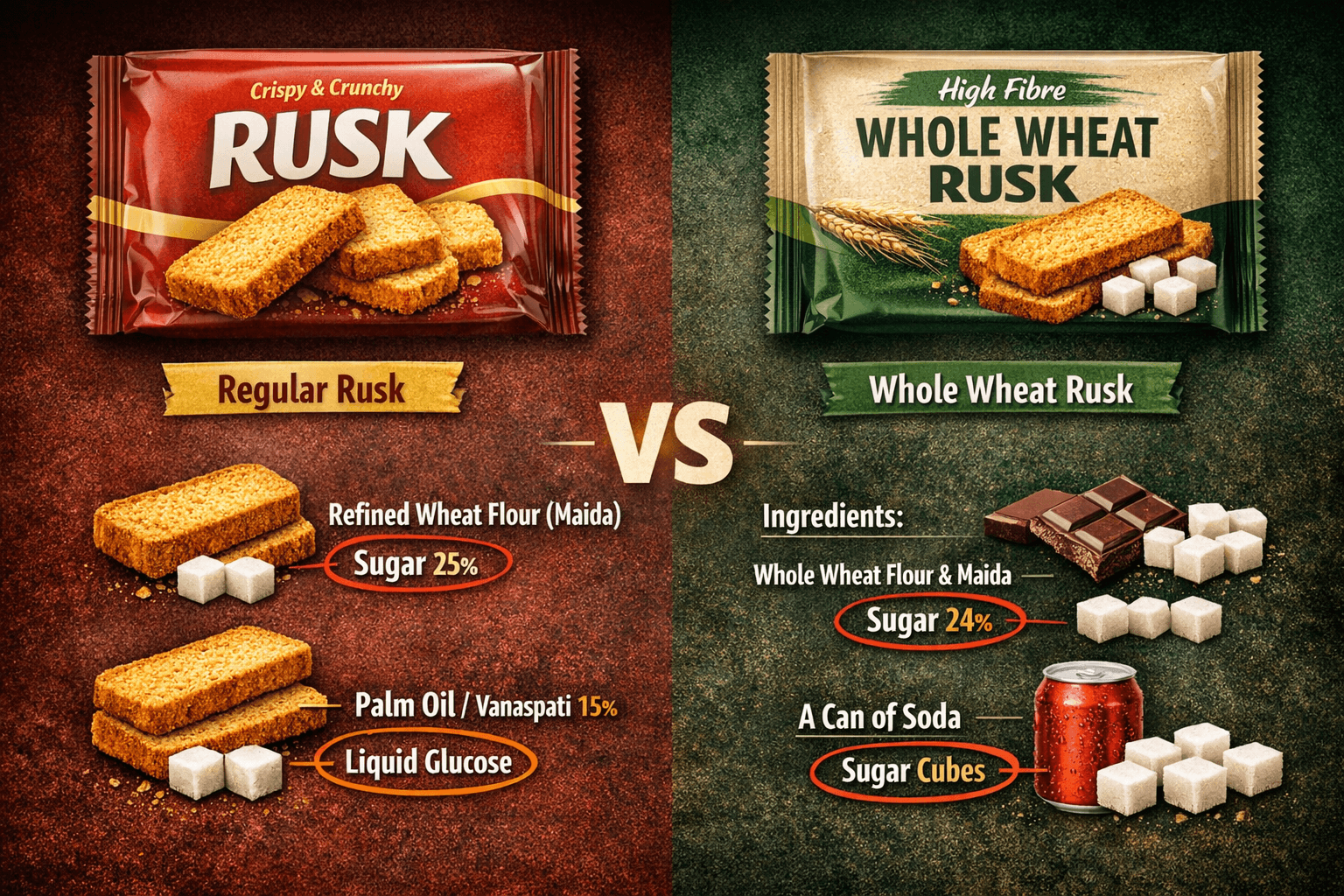
Some brands have caught on to the health-conscious consumer. You'll now find rusks labeled "Whole Wheat," "Multigrain," or "High Fiber." But here's the catch: read the ingredient list, not the front of the box.
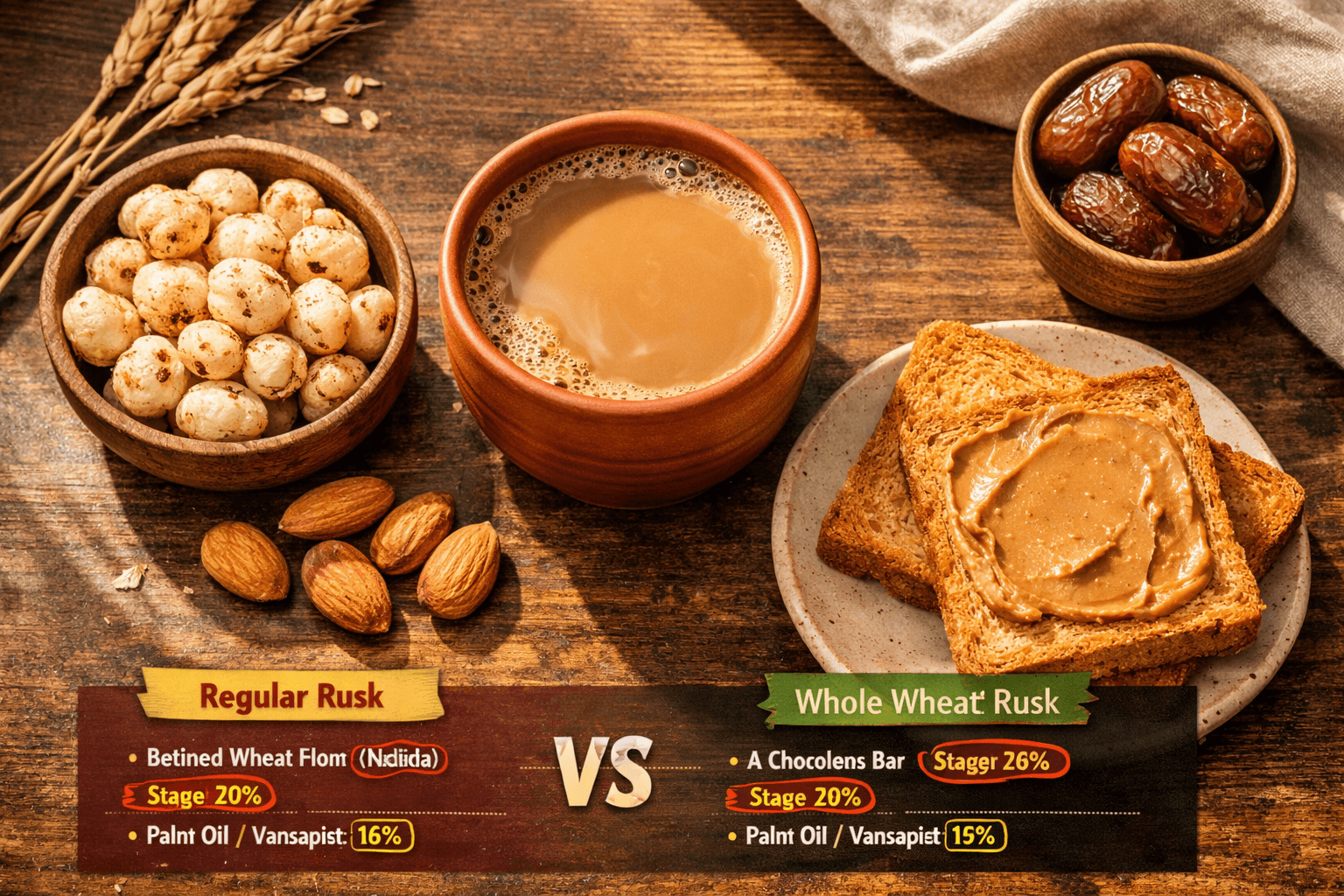
In most cases, "Whole Wheat Rusk" still lists Refined Wheat Flour (Maida) as the first ingredient. The whole wheat flour is secondary. By food labeling law, ingredients are listed in descending order of quantity. If Maida is first, it forms the majority of the product. The "whole wheat" is a token addition — often less than 15% — just enough to put on the label.
The sugar content in these "healthy" variants? Almost identical to the regular version. The palm oil? Still there. The only thing that changed is the color of the packaging and the font size of the word "Wheat."
What to Eat Instead
The goal isn't to kill the ritual. Chai is sacred. But the companion can change.
- Roasted Makhana (Fox Nuts): Low in calories, high in protein and phosphorus. Crunchy, satisfying, and genuinely light. A 30g serving has less than 2g of sugar and zero trans-fats.
- Roasted Chana (Chickpeas): A traditional Indian snack that's high in fiber and protein. It digests slowly, keeping you full longer without the sugar spike.
- Homemade Whole-Wheat Toast: If you need bread, make it fresh. Two slices of actual whole-wheat bread (check that whole wheat flour is the FIRST ingredient), lightly toasted, with a thin spread of peanut butter or ghee. You control every ingredient.
- Dry Fruits (Small Handful): Almonds, walnuts, or a few dates. The natural sugars in dates satisfy the sweetness craving while providing fiber, magnesium, and potassium.
The next time you reach for that golden rusk, pause for five seconds and flip the packet over. Read the first three ingredients. If they are Maida, Sugar, and Palm Oil — you now know exactly what you're eating.
It's not a light snack. It's a processed product dressed in nostalgia.

Reading Time
10 min read