
Slouching – The Silent Killer
Fix Your Posture, Save Your Spine
Most of us spend somewhere between 8 and 12 hours a day sitting. Whether it's at a cramped college desk during a back-to-back lecture marathon, a corporate workstation lit by fluorescent lights, or even just the couch at home while scrolling through reels — the "slouch" has quietly become the default position of an entire generation. It feels natural. Comfortable, even. But that comfort is a lie your body tells you while it slowly falls apart.
Slouching is not just a bad habit your parents warned you about. It is a biomechanical dysfunction that, over months and years, rewires how your muscles, bones, and even your internal organs function. And the worst part? By the time you feel the damage, it's already years too late to undo it easily.
The 15-Degree Tilt That Changes Everything
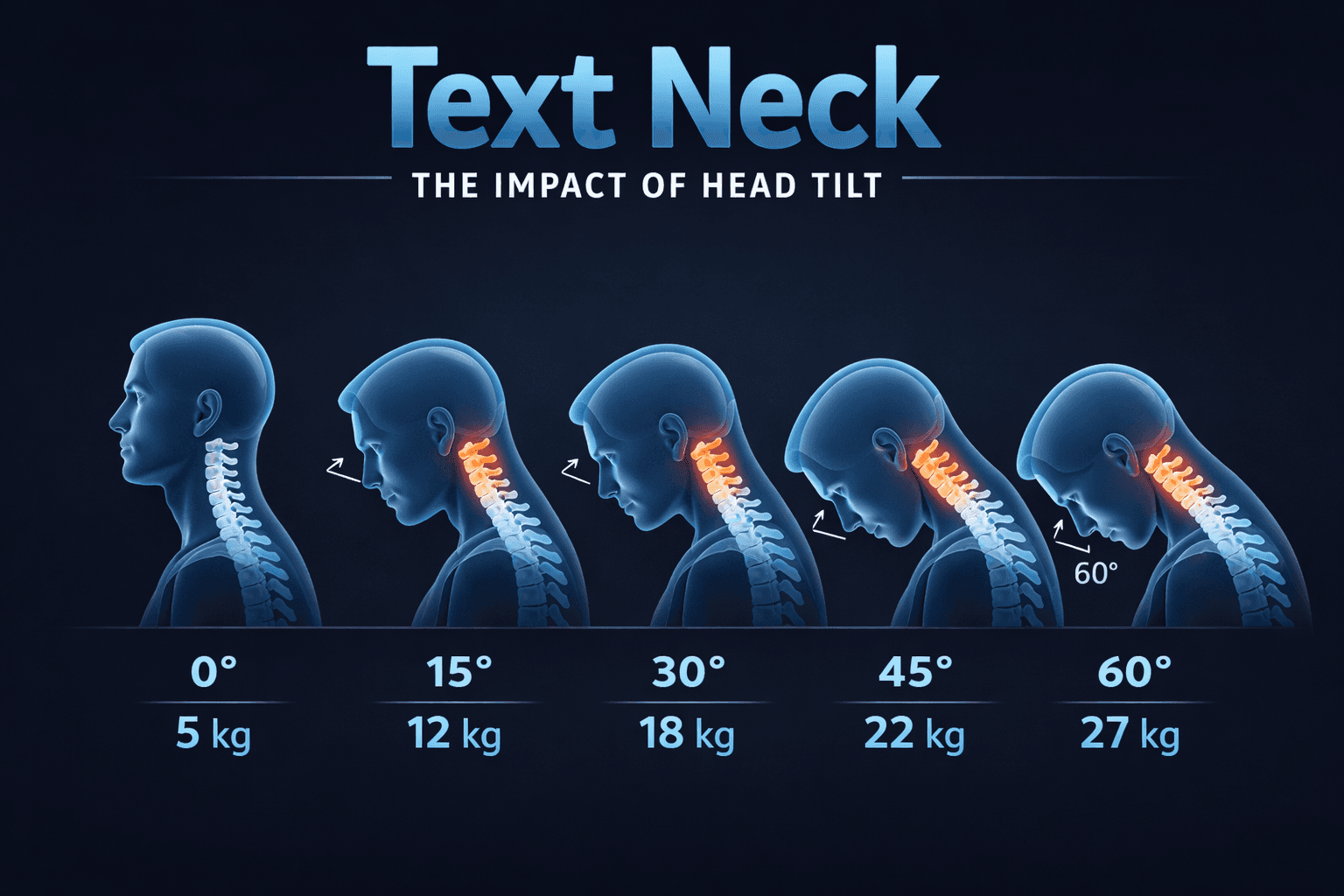
Here's a number that should scare you: your head weighs approximately 5 kilograms. That's roughly the weight of a bowling ball. When your head is aligned directly over your spine — ears stacked over shoulders — your neck supports exactly that: 5kg. Manageable. Effortless.
But for every inch your head tilts forward, its effective weight on your cervical spine doubles. Tilt it 15 degrees forward — the casual "I'm just checking my phone" angle — and your neck is now bearing around 12kg. At 30 degrees, the position most people sit in while working on a laptop, it's closer to 18kg. And at 45 degrees, the full "text neck" posture, your neck muscles are struggling under nearly 22kg of force. That's the weight of a carry-on suitcase. Hanging off your neck. For hours.
This isn't theoretical. A 2014 study published in *Surgical Technology International* by Dr. Kenneth Hansraj mapped the exact weight distribution at each angle. His conclusion was blunt: "Loss of the natural curve of the cervical spine leads to incrementally increased stresses about the cervical spine. These stresses may lead to early wear, tear, degeneration, and possibly surgeries."
The Chain Reaction You Don't See
Most people think bad posture is a back problem. It's not. It's a whole-body problem.
When you slouch, your chest compresses. Your ribcage has less room to expand. This directly limits your lung capacity — studies have shown that slouching can reduce your oxygen intake by up to 30%. Less oxygen means less energy, more fatigue, and a brain that's working harder to do less. Ever wonder why you feel mentally drained after a long day of sitting? It's not just the work. It's the way you were sitting while doing it.
But it goes deeper. A compressed torso pushes down on your stomach and intestines. Digestive efficiency drops. Acid reflux, bloating, and constipation are all significantly more common in people who sit with poor posture for extended periods. Your body was designed to digest food while upright — not folded in half like a closing laptop.
And then there's the psychological impact. Research from the University of Auckland found that sitting upright improved mood, reduced fatigue, and decreased self-focus in people with mild to moderate depression. Conversely, participants who sat in a slumped posture used more negative emotion words, reported lower self-esteem, and experienced greater fear. Your posture doesn't just reflect your mood — it actively shapes it.

The "Text Neck" Epidemic
In India, the average smartphone user spends over 4.5 hours a day on their device. For college students, that number jumps to nearly 7 hours. Now combine that with 4-6 hours of lectures, and you have a generation that spends the vast majority of its waking hours with their chin buried in their chest.
Physiotherapists across the country are reporting a surge in patients under 25 coming in with cervical spondylosis — a condition that was once almost exclusive to people over 50. Disc degeneration, nerve compression, and chronic tension headaches are becoming normal in 22-year-olds.
The spine has a natural S-curve. Chronic forward head posture flattens the cervical curve first, then starts rounding the thoracic spine (the middle back). Over time, this creates the classic "hunchback" shape that becomes increasingly difficult — and eventually impossible — to reverse without intervention.

The 1-Minute Fix (That Actually Works)
You don't need a ₹1,00,000 ergonomic chair. You don't need a standing desk or a posture-correcting brace. What you need is awareness and three simple rules.
1. The String Rule
Imagine a string attached to the crown of your head, gently pulling you toward the ceiling. Don't force your shoulders back or puff your chest out — just let that invisible string lift you. Your body knows its natural alignment. This mental cue activates it.
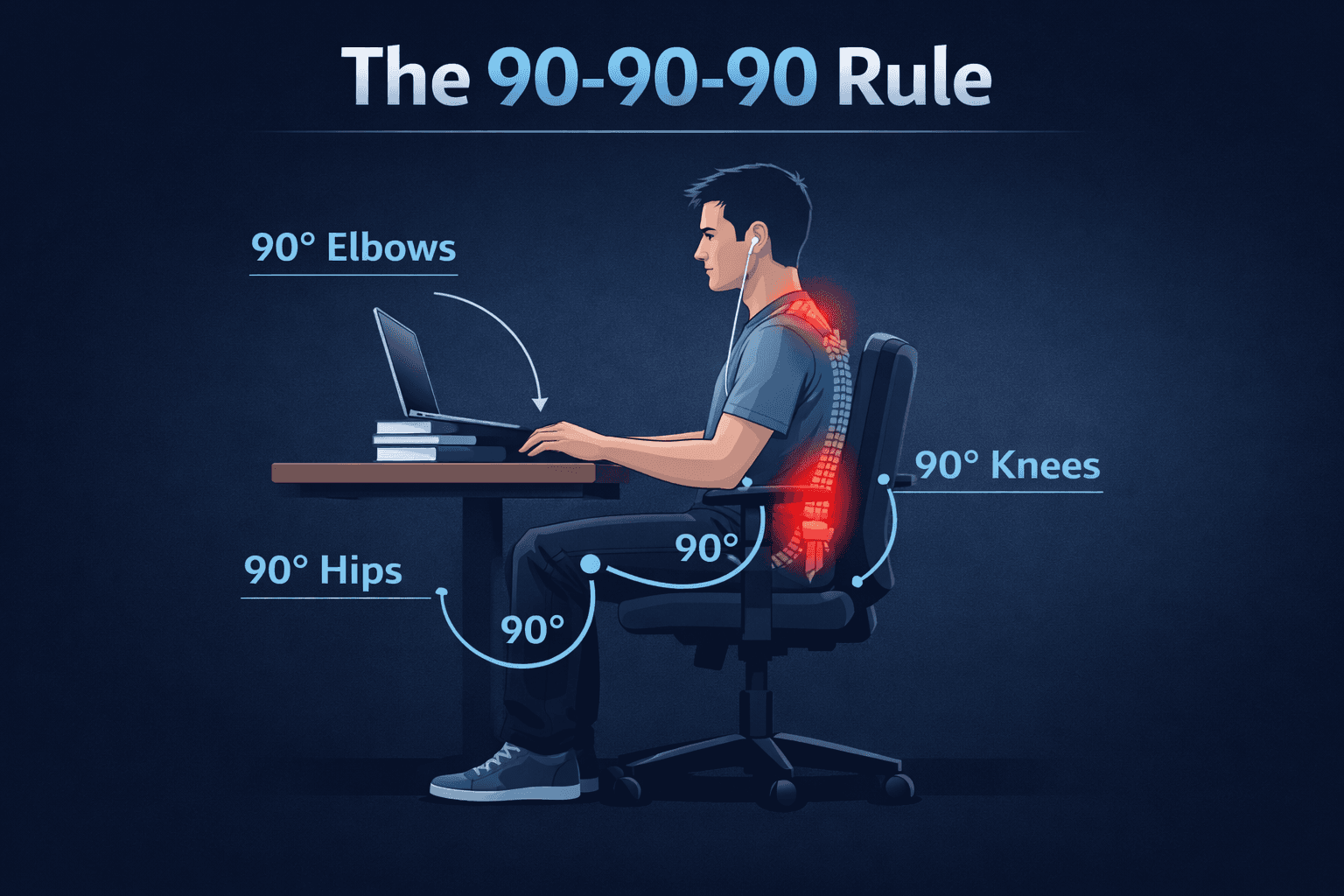
2. The 90-90-90 Rule
When seated, aim for three 90-degree angles: elbows at 90° on the armrests or desk, hips at 90° in the chair, and knees at 90° with feet flat on the floor. This distributes your weight evenly and takes the load off your lower back.
3. The Eye-Level Reset
The simplest and most impactful change: raise your screen. Your laptop, monitor, or phone should be at a height where the top third of the screen is at eye level. Stack some books under your laptop. Hold your phone up instead of looking down. This single adjustment eliminates the forward head tilt entirely.
4. The 20-Minute Rule
Set a timer. Every 20 minutes, stand up, roll your shoulders backwards five times, and take three deep breaths. It takes 15 seconds and resets your postural muscles before they lock into the slouch position.
The Long Game
Your spine is the central highway of your nervous system. Every signal from your brain to your body — and back — travels through it. Compressing it, twisting it, and folding it for 10+ hours a day doesn't just cause back pain. It degrades the quality of every function your body performs.
The change doesn't start with a gym membership or a doctor's visit. It starts the next time you catch yourself slouching and choose to sit up. That one-second decision, repeated hundreds of times, will do more for your body than any supplement on the market.
Your future self will thank you. Or your future self will be paying a physiotherapist ₹2,000 per session to fix what you could have prevented for free.
The choice is yours. Sit up.

Reading Time
9 min read