
The 20-20-20 Rule
The 20-Second Habit That Can Save Your Eyes
The modern human eye was not designed for the world we now live in.
For almost the entire history of our species, our eyes were built to do two things: look far into the distance and track movement in natural environments. Our ancestors scanned forests, fields, and horizons. Their eyes constantly shifted focus between near and far objects. Muscles around the eye were always in motion.
But today, a typical student or office worker spends 8 to 12 hours a day staring at a flat rectangle of light.
Laptop screens.
Phones.
Tablets.
Lecture projectors.
Television.
The distance rarely changes. The brightness rarely changes. The muscles responsible for focusing remain locked in a single position for hours.
The result is something ophthalmologists now call Digital Eye Strain — a condition so common that it affects over 65% of people who use screens for more than four hours a day.
Symptoms include:
Burning or dry eyes
Blurry vision
Headaches
Sensitivity to light
Difficulty focusing
Neck and shoulder pain
Most people respond the same way when these symptoms appear.
They rub their eyes.
Blink a few times.
Maybe splash some water.
And then they go right back to the screen.
But there is a deceptively simple rule — developed by eye specialists — that can dramatically reduce this strain.
It takes only 20 seconds.
It requires no equipment.
And when practiced consistently, it can protect your eyesight for decades.
It's called the 20-20-20 Rule.
The Biological Problem Behind Screen Fatigue
To understand why the 20-20-20 rule works, we first need to understand what exactly screens do to the eye.
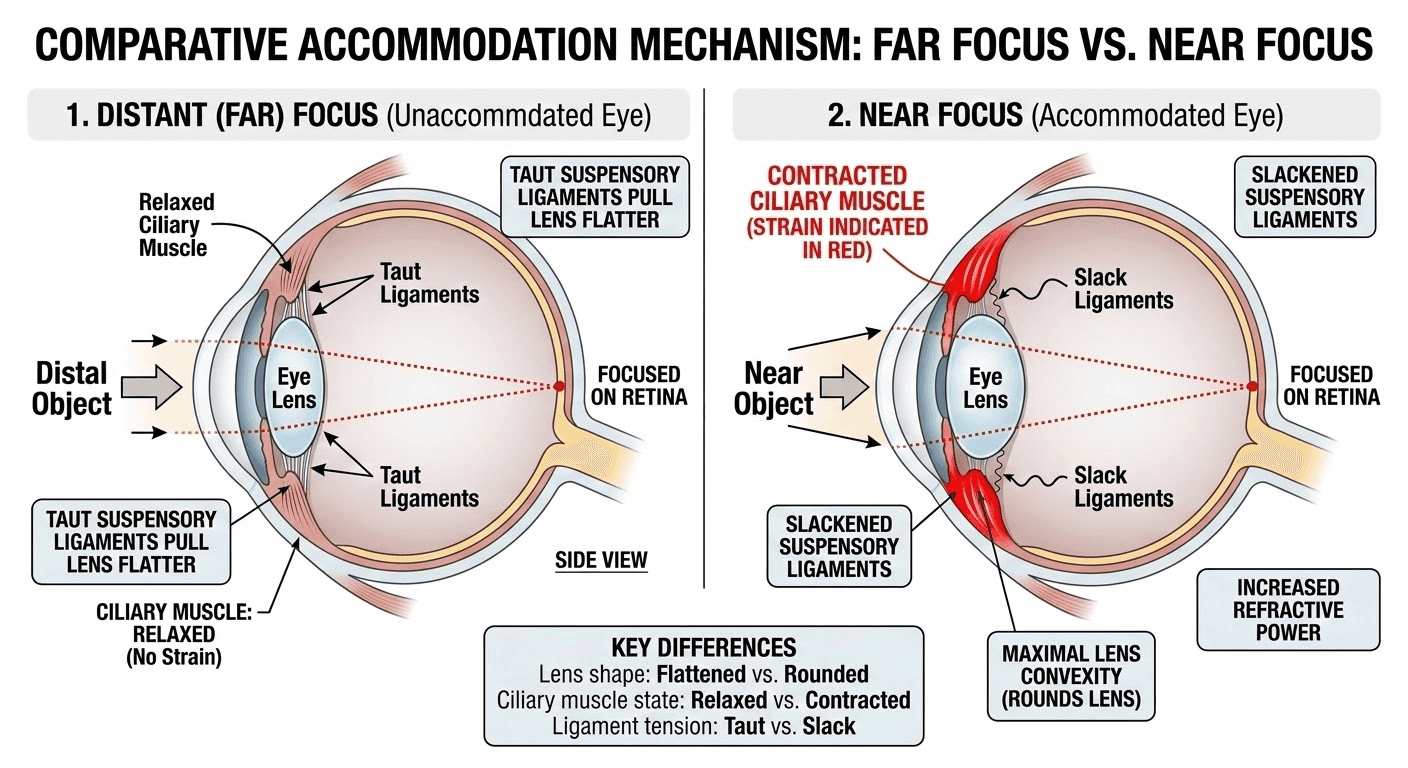
Your eyes contain a tiny ring-shaped muscle called the ciliary muscle. Its job is to control the lens of your eye, adjusting focus depending on how far away an object is.
When you look at something close — like a phone — the muscle contracts.
When you look at something far away — like a tree — the muscle relaxes.
This constant contracting and relaxing is how your eye maintains healthy flexibility.
But screen use disrupts this cycle.
When you stare at a laptop or phone for hours, your eyes remain locked at a fixed near distance, usually around 30–50 cm. The ciliary muscle stays contracted continuously.
Imagine clenching your fist for three straight hours without relaxing it.
Eventually it would start to ache.
The same thing happens inside your eyes.
This is called accommodative spasm, where the eye's focusing system becomes temporarily stuck in near-focus mode.
And that's when symptoms begin:
Distant objects become blurry
Headaches develop around the temples
Eyes feel tight and sore
The Hidden Role of Blinking
Another problem caused by screens is something most people never think about: blinking frequency.
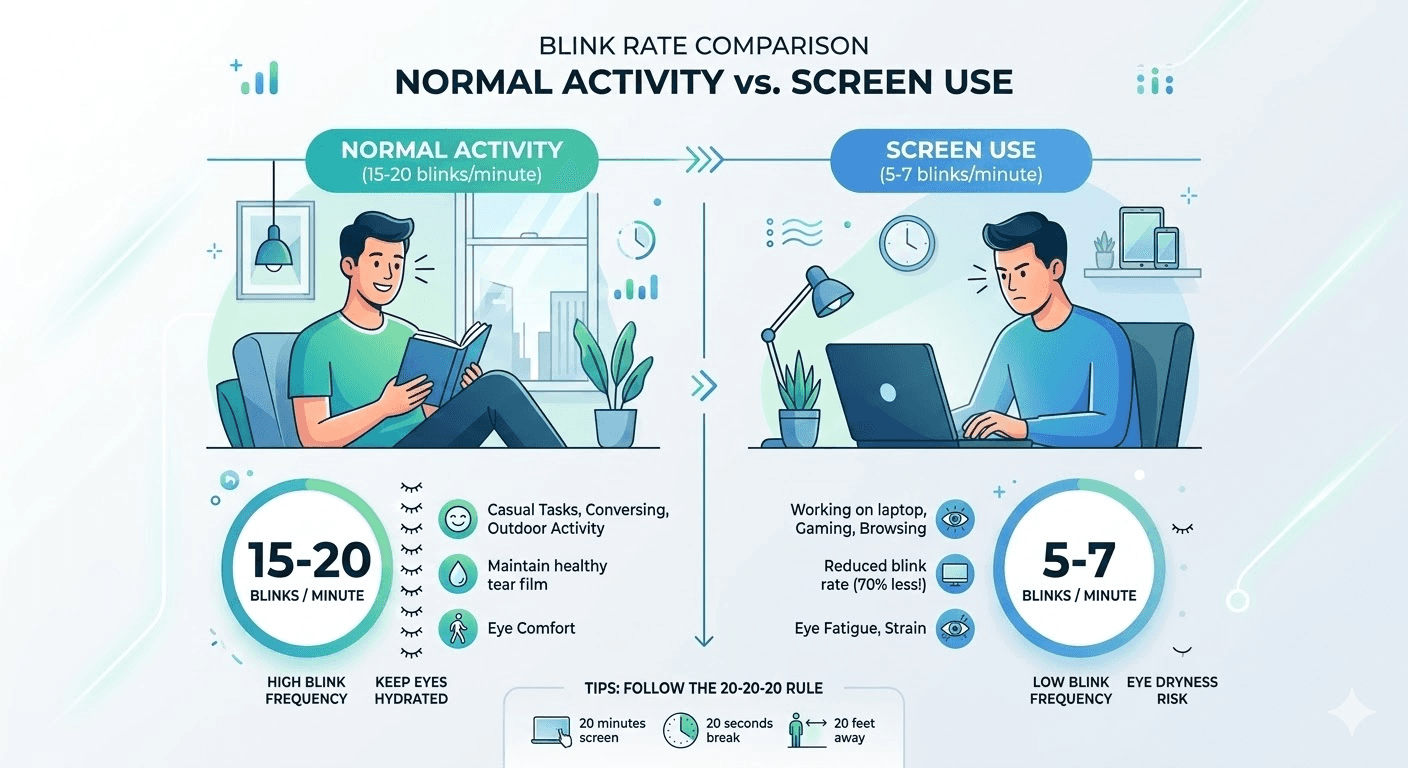
The average human blinks about 15–20 times per minute under normal conditions.
Blinking spreads a thin layer of tears across the eye's surface, keeping it lubricated and comfortable.
But when we stare at screens, something strange happens.
Our blink rate drops dramatically.
Studies show that people using computers blink as little as 5–7 times per minute — less than half the normal rate.
Why?
Because the brain becomes intensely focused on visual information. Each blink interrupts that information for a split second, so the brain unconsciously suppresses blinking.
The result is dry eyes.
Without enough blinking, the tear film evaporates quickly, leaving the eye exposed to air. This causes irritation, redness, and that familiar gritty sensation many people feel after long study sessions.
Combine reduced blinking with continuous near focusing, and you have the perfect formula for eye strain.
The Birth of the 20-20-20 Rule
Eye specialists began noticing something interesting among computer workers in the late 1990s.
People who occasionally looked away from their screens — even briefly — experienced significantly fewer symptoms of digital eye strain.
This led optometrists to design a simple guideline that would force the eye muscles to reset periodically.
The result was the 20-20-20 rule.
The rule is simple:
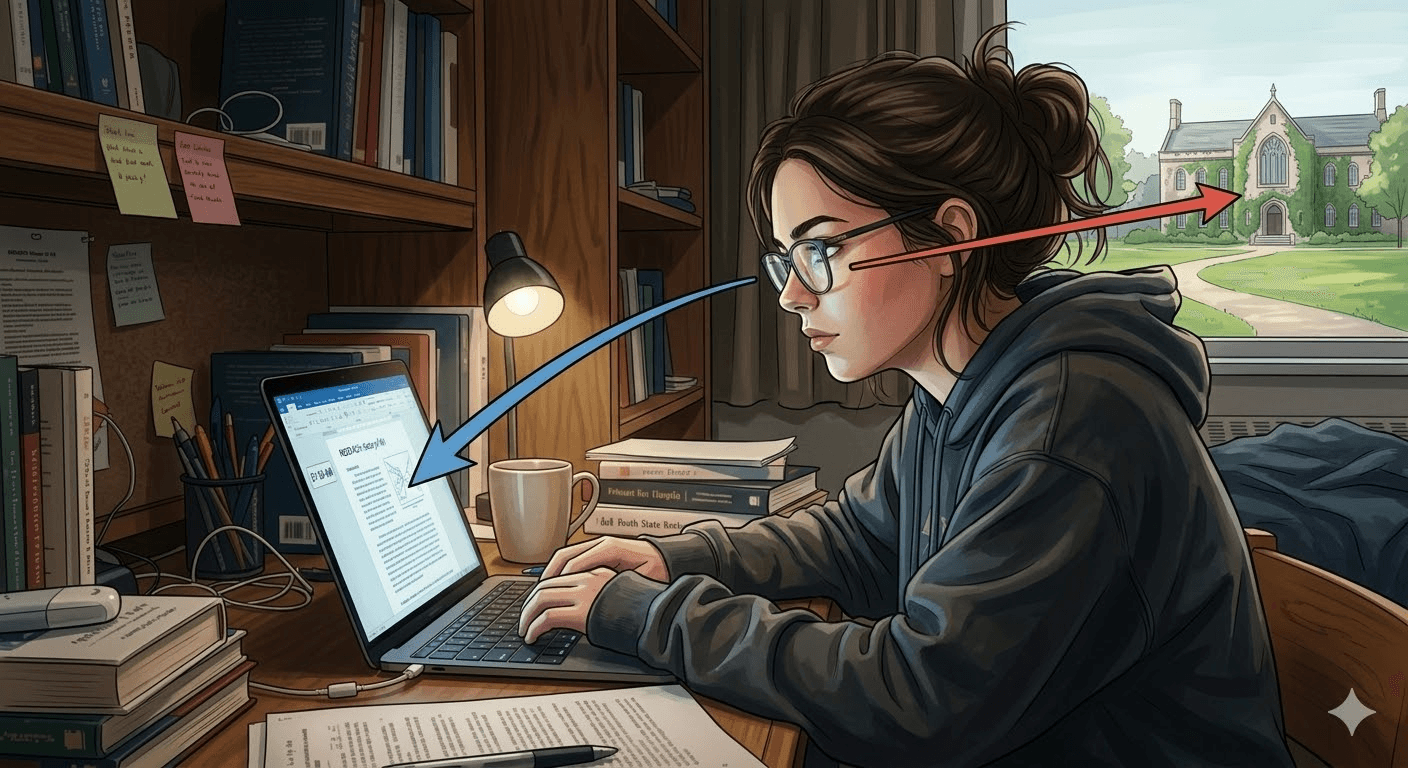
Every 20 minutes, look at something 20 feet away for 20 seconds.
That's it.
Those 20 seconds allow the ciliary muscles to relax completely, restoring normal flexibility to the eye's focusing system.
It also encourages blinking, which refreshes the tear film and reduces dryness.
Think of it like stretching during exercise.
Your muscles work better when you give them short breaks between effort. Your eyes are no different.
Why 20 Feet?
The number might sound arbitrary, but it isn't.
At approximately 20 feet (6 meters), the human eye reaches something called optical infinity. This means the lens no longer needs to actively focus.
In practical terms, looking at something 20 feet away is the equivalent of giving your eye muscles a full relaxation break.
Anything closer than that still requires a small amount of focusing effort.
So when the rule says 20 feet, it means something like:
A building outside your window
The end of a hallway
A distant tree
A far wall across the room
The key idea is distance.
Your eyes need contrast between near work and far vision to stay healthy.
Why Students Need This Rule More Than Anyone
Students today experience one of the most extreme visual workloads in human history.
Consider a typical college day:
Morning:
2–3 hours of lectures with projector screens.
Afternoon:
Laptop assignments, coding, or research.
Evening:
Phone scrolling, messaging, or YouTube.
Night:
Study sessions before exams.
Total screen exposure can easily exceed 10–12 hours daily.
For engineering students, programmers, designers, and gamers, the number can climb even higher.
Ophthalmologists are now reporting a growing number of young adults with symptoms previously seen mostly in older office workers.
Some of the most common problems include:
Chronic dry eyes
Early myopia progression
Frequent headaches
Sensitivity to light
Eye fatigue during reading
These issues often appear gradually, making them easy to ignore until they become severe.
The 20-20-20 rule works because it interrupts this continuous strain cycle before damage accumulates.
How to Actually Use the Rule in Real Life
The biggest challenge with the 20-20-20 rule is remembering to do it.
When you're deeply focused on work or studying, time passes quickly. Hours can disappear without a single break.
The solution is to make the rule automatic.
Here are practical ways to implement it.
1. Use a Timer
Set a repeating 20-minute timer on your phone or smartwatch. When it rings, look away from your screen immediately.
2. Use Environmental Triggers
Every time you finish a paragraph, a coding block, or a problem set — look up and scan the room.
3. Combine it with Standing
Every 20 minutes:
Stand up
Look out the window
Take three deep breaths
This helps your posture and circulation at the same time.
4. Blink Intentionally
While looking at the distant object, blink slowly several times. This refreshes the tear film and relieves dryness.
[Image 5 — BODY: Minimalist illustration showing a student standing by a window, stretching and looking outside while a laptop sits on the desk behind them. Bright natural light.]
Small Habits That Multiply the Benefits
While the 20-20-20 rule is powerful, combining it with a few additional habits can dramatically improve eye health.
Adjust Screen Height
The top of your screen should be at or slightly below eye level. This prevents excessive eye opening, which contributes to dryness.
Reduce Screen Brightness at Night
High brightness in dark environments increases eye strain. Use night mode or blue-light filters after sunset.
Increase Text Size
Straining to read small text forces your eyes to focus harder.
Stay Hydrated
Dry eyes worsen with dehydration. Drinking enough water improves tear production.
Use Natural Light
Whenever possible, work near windows or natural light sources instead of relying entirely on artificial lighting.
These small adjustments create a work environment that respects the biology of the eye rather than fighting it.
The Long Game: Protecting Vision for Decades
Your eyesight is one of the most complex and valuable systems in your body.
Yet most people treat it like an unlimited resource — something that will always work no matter how poorly it is used.
The truth is that visual fatigue accumulates slowly over time.
Years of continuous strain can lead to worsening vision, chronic dryness, and persistent headaches.
But the opposite is also true.
Small protective habits compound over decades.
The 20-20-20 rule may seem trivial — just 20 seconds every 20 minutes.
But over a 10-hour study day, that adds up to 30 micro-breaks for your eyes.
Thirty chances for your eye muscles to relax.
Thirty chances to blink, hydrate, and reset.
Tiny interventions like this are how long-term health is preserved.
The next time you're buried in a screen — coding, studying, or binge-watching lectures — remember this simple rule.
Every 20 minutes.
Look 20 feet away.
For 20 seconds.
Your future eyes will thank you.

Reading Time
10 min read